
APWA Accreditation and a Model Communications Practice
A reflection on a nationally recognized model communications practice, why clear standards matter in public service, and how a 24-hour response expectation improves trust.
Dave Reno
1/16/20265 min read
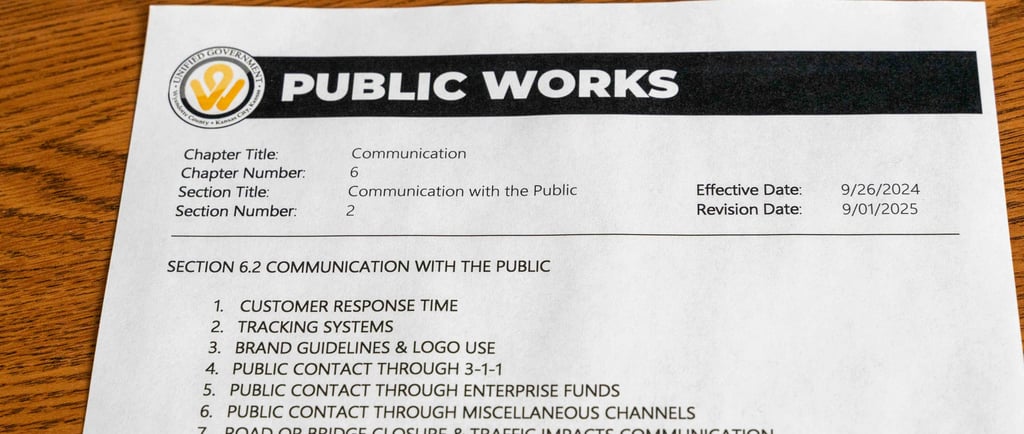
As part of our recent accreditation, Public Works was recognized with four model practices. One of them focused on communication with the public. That practice is Section 6.2, Communication with the Public, and it is one that I developed.
Section 6.2 outlines how Public Works communicates with residents during projects, service disruptions, and other activities that affect the public.
This recognition matters, but not simply as an accolade. In this context, model practices are identified through peer review and shared nationally because they demonstrate an approach others can learn from. That is the real honor, and one I am genuinely grateful for.
Out of respect for the American Public Works Association (APWA), I will not share the full practice here. Model practices are a professional resource for APWA members. If you want to review it in full, I would encourage you to join.
What I will share is one small part. My favorite part, in fact.
It is a favorite because it’s simple, somewhat controversial, and has an outsized impact on improving public trust and perception.
Before we jump into it, let's talk generally about Section 6.2. Section 6.2 was built primarily to accomplish two things:
Capture how the department already operates when communication is working well
Increase capacity through systems
Section 6.2 establishes clear expectations for when public communication is required, how extensive that communication should be, and when coordination with Public Works’ communications function is necessary. By doing so, it reduces confusion, prevents duplicated work, gives staff a shared point of reference when questions or needs arise, and gives me the capacity to focus on the department’s most pressing communications needs.
In many organizations, teams rely on informal understanding, case-by-case judgment, or expert knowledge held by a few individuals. This is problematic for a variety of reasons, but two rise to the top.
The first is leadership development. When knowledge lives only in an individual, it may not always be shared. In some cases, it may be guarded because the individual fears becoming irrelevant if everyone knows how to do what they do. That’s a real fear leaders need to help others overcome, but that discussion is for another day. Developing practices like this help make that knowledge available to everyone on your team. It helps everyone grow.
The second, and more bluntly, is what happens if Dave’s in a coma? What happens if the person you rely on is suddenly not available to do what they normally would? This is a real thing and it can be quite damaging for teams and organizations.
A good practice can solve both of these issues. Practices make information available to everyone and help develop the leaders around you. They also protect the organization from losing critical knowledge by writing expectations down in a way others can use. Both are good things. Both are things leaders should be implementing intentionally.
The structure of a practice can also support capacity building. In the case of Section 6.2, team members are not expected to guess whether something requires public communication or how far that communication should go. The guidance is there. At the same time, it clearly defines when my involvement is required. That balance allows decisions to happen closer to the work while maintaining consistency across the department. It also allows me to focus the time gained on other communications activities.
So that leads us to my favorite standard in this practice: the 24-hour customer response expectation.
Public servants are in the customer service business. All of us, regardless of title or experience. Do you patch potholes? You’re in the customer service business. Are you a city manager? You’re in the customer service business. Every team member within Public Works is in this business, and we owe our residents timely, respectful service.
The 24-hour customer response expectation is straightforward. If a resident reaches out to a team member with a question, concern, comment, or request, the team member has 24 clock hours to respond.
Not 24 business hours.
If a call comes in at 3 p.m., the team member has until 3 p.m. the following day to respond.
A response does not mean a solution. A response means acknowledging the request, confirming it was received, and setting a reasonable expectation for what comes next.
A simple acknowledgment within 24 clock hours prevents unnecessary escalation, builds trust, and shows respect for the person who reached out. This standard was not created to encourage performative busyness or unrealistic expectations. It was created to remove ambiguity for staff and for the public.
You might be surprised how many people push back on this standard as being too difficult to meet. Maybe you’re one of those people. Responding within 24 hours isn’t just possible, it’s the standard we should challenge ourselves to meet. If you respond in 12, six, or four hours, even better!
There should never be a situation where a resident waits days for a call back because we’re too busy with other things. Your residents are more important than those other things. They are the reason why you can work on those other things in the first place.
One of the most common questions I get about this is “What if I'm on vacation?” It's a fair question with a simple solution: Use an email autoresponder. Auto responses count. Why? Because the person emailing you gets an immediate response and they know you'll follow up when you return.
This isn't the only way, of course. Phone mailboxes can have their greeting changed to indicate you're away. Phone calls can be forwarded to your organization's call center. You can identify a delegate who will respond to emails for you while you’re out.
Whatever you do, do not leave your residents hanging. How would you feel if you dropped your vehicle off for an oil change in the morning, called for an update that afternoon, and the mechanic waited three days to call you back because they were working on other things? I can't imagine you'd be happy. Or ever go there again, in fact.
When you leave residents hanging, they'll start making stuff up, and that stuff will be negative (Hey there, negativity bias! Welcome to the chat!). Silence harms your credibility and the credibility of your organization. It degrades public trust, it degrades the perception of goodwill, and it degrades perceptions of competence.
I wonder how many people who think local government isn't trustworthy simply because they haven't gotten a return call. Probably more than we'd like to admit.
Moments like that are why standards matter. Not because they are rigid, but because they remove uncertainty before it turns into frustration.
The point of setting standards like this is not to win arguments about response time. It is to make expectations explicit before pressure sets in.
Section 6.2 is built around the idea that clear standards reduce friction. When expectations are defined in advance, fewer decisions have to be renegotiated in the moment. Work moves faster. Roles are clearer. Accountability is easier to maintain.
This is not unique to Public Works. Any organization serving the public faces the same pressures and the same temptation to excuse delays or inconsistency. The difference is whether leaders choose to define expectations clearly and hold to them.
Leadership Takeaway
If you want to reduce confusion and duplicated work in your organization, resist the urge to solve problems with more communication.
Instead, define expectations. Write them down. Give people something they can reference when questions arise, and apply those standards consistently.